

Sustainability
Why We're Growing Toward Pongamia
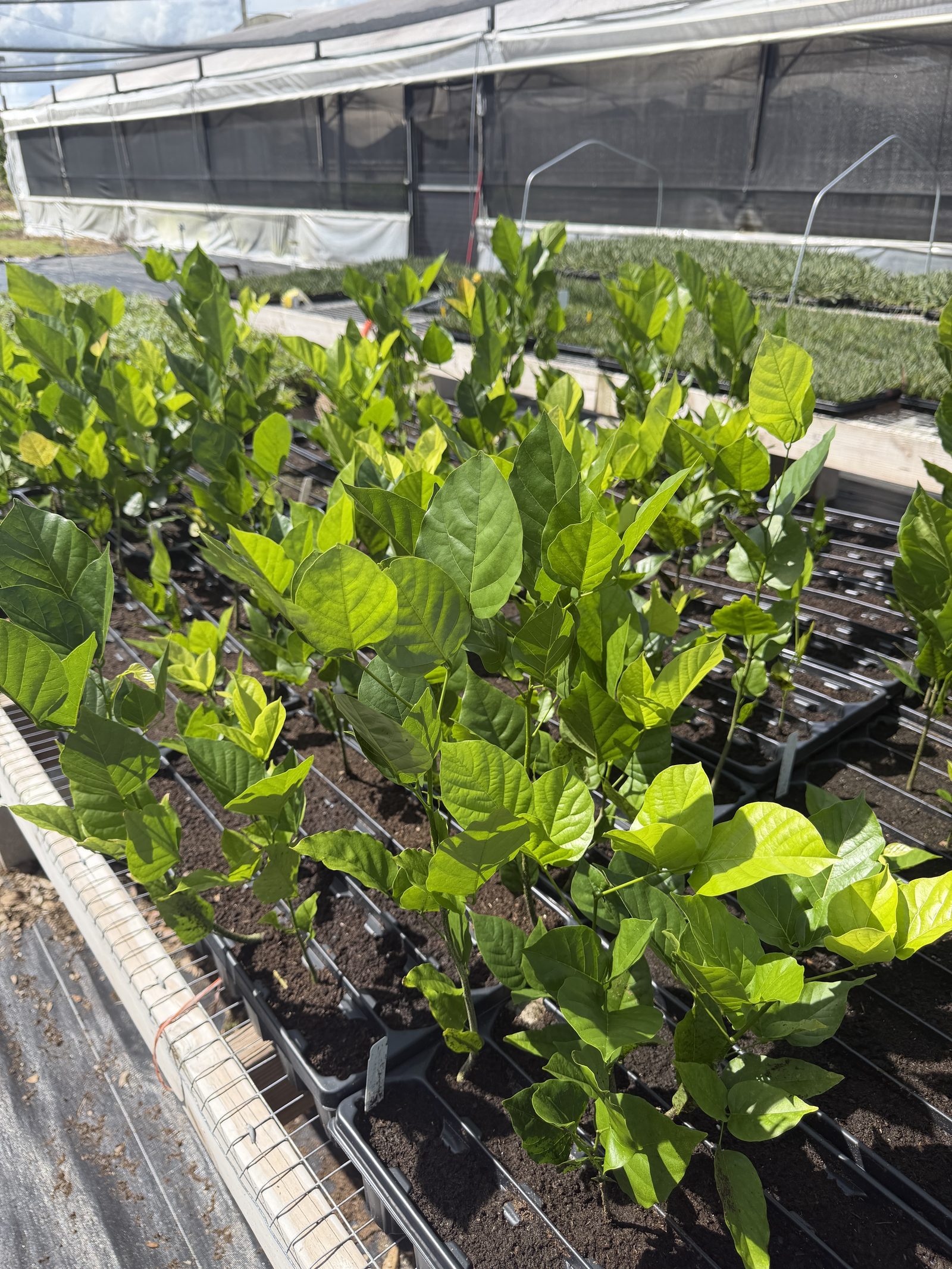
We've planted the seeds. Now we're growing more than 900 pongamia seedlings toward our first five-acre planting site, targeted for late 2027 — for soil we can rebuild, carbon we control ourselves, and a renewable oil already in demand for aviation fuel and consumer goods.
Drive through Central Florida today and you'll pass grove after grove that used to mean something — rows of citrus trees, planted by families who built a living on orange juice and grapefruit, now standing half-empty or bulldozed flat. Citrus greening has done in twenty years what freezes and hurricanes couldn't do in a century: it broke the economics of Florida citrus. Statewide orange production is down more than 90 percent since the disease arrived in 2005. That land didn't stop being valuable. It just stopped having a crop.
We think it has one now.
That's why we've started growing pongamia — Millettia pinnata, a hardy, subtropical legume tree with a long history in South Asia and Australia and a growing one here in Florida. We're early, and we want to be honest about exactly how early: we've planted our seeds, we're now tending more than 900 seedlings, and we're working toward our first five-acre planting site, targeted for late 2027. This is a goal we're building toward step by step, not a finished grove — and we think that's worth saying plainly rather than dressing up.
We didn't choose pongamia because it's trendy. We chose it because it does three things at once that almost nothing else growing in this state can: it rebuilds the soil citrus exhausted, it locks away carbon on terms we control ourselves, and it produces an oil with a real, growing market in renewable fuel and consumer goods. Here's why that combination matters to us, why we're building toward it in stages, and why we think it should matter to Florida agriculture more broadly.
Land that citrus gave up on, working again
Pongamia isn't picky. It tolerates the drought years and the flood years. It shrugs off the pests and diseases that made citrus greening a death sentence for orange groves. And because it's a legume, it fixes its own nitrogen from the air instead of pulling it from the ground — which means it needs little to no synthetic fertilizer and virtually no pesticide program to stay productive. After decades of intensive citrus cultivation, that's not a minor detail. It's the difference between land that keeps degrading and land that starts to recover.
Our plan is to grow into acreage that would otherwise sit fallow — grove infrastructure, irrigation, and access roads that citrus farmers built and citrus greening made obsolete. Instead of asking that land to support another input-heavy row crop, we want to give it a tree that improves it while it grows: deeper root systems holding soil in place, organic matter building back up, nitrogen cycling naturally instead of being trucked in by the bag. Pongamia is also a long-lived perennial that stays productive for decades once established, not just a season or two — closer to what citrus groves once were: a generational asset, just built around a different tree. Right now that's still seedlings in nursery rows; the first five acres in the ground is the milestone we're working toward.
Carbon we can actually stand behind
A lot of “carbon offset” language in agriculture today is borrowed — credits bought from someone else's project, in someone else's forest, verified by someone else's model. We wanted something more direct. Because we're growing pongamia ourselves, on our own land, from our own seedlings, we control the carbon story end to end: what's planted, how it's managed, and how the sequestration is measured over the life of the grove. That's a very different claim than “we purchased offsets,” and we think it's a more honest one — even while our own numbers are still ahead of us rather than behind us.
Pongamia is well suited to that kind of accounting. It's a fast-establishing woody perennial with substantial biomass above and below ground, and current research into its carbon sequestration potential is encouraging, particularly on the kind of marginal and degraded agricultural land we're planting into. We're not going to overstate where the science currently stands — measurement and third-party verification take time, and we intend to do that work properly rather than rush a number out. But growing the trees ourselves means that when we do talk about carbon, it's our carbon, on our land, that we can trace.
The math, acre by acre
The specifics vary by soil and grove age, but here's the shape of what we're building toward — drawn from published research and industry agronomic data on pongamia grown in former Florida citrus rows, not yet our own measured results, which we'll publish honestly once our groves are old enough to report them.
For comparison, an acre of soybeans yields roughly 40 gallons of oil — about a tenth of what a mature acre of pongamia is reported to produce. Counting from a late-2027 planting, that puts our first meaningful harvest in the early 2030s, which is exactly why we're starting the clock now rather than waiting. These are industry planning figures, not our own audited numbers.
One tree, two industries: fuel and consumer goods
Here's the part that makes this more than a conservation project: pongamia seed produces a non-edible oil that's genuinely useful, at scale, in two markets that are both actively looking for exactly this kind of feedstock.
The first is aviation. Airlines and fuel producers are under real pressure to cut the carbon intensity of jet fuel, and sustainable aviation fuel (SAF) made from non-food oil crops is one of the few credible paths at commercial scale. Pongamia has drawn serious attention here — reportedly yielding several times the oil per acre compared to soybeans, without competing with food crops for cropland — and partnerships between pongamia growers and major energy and trading companies have already begun moving this from research into supply agreements. We're growing into that demand curve, not ahead of it blind.
The second is consumer products. Once the oil is pressed, what's left is a high-protein meal that can be refined into food-grade protein for baking, smoothies, and protein products, alongside the oil itself, which has applications ranging from biodiesel to specialty consumer formulations. That's a second revenue stream off the same harvest, and it's part of why we see pongamia as a genuine crop — not just a fuel-feedstock experiment.
Where we are, and where we're headed
We're not walking away from citrus out of sentiment, and we're not growing pongamia because it's a headline. We're doing it because the land needs something that heals it instead of depleting it further, because carbon claims mean more when you can point to the ground they came from, and because there's real, growing demand for what this tree produces — in the sky and on the shelf.
Right now, that means seeds in the ground and more than 900 seedlings under our care, with our first five-acre planting site targeted for late 2027. That's the milestone we're building toward — not a distant vision, but the next concrete step. We'll share real numbers on acreage, yield, and verified carbon as those five acres go in and the groves mature enough to report them honestly. For now, the goal is set, the seedlings are growing, and we intend to be doing this at scale for a long time.
Want to see it for yourself?
This is a project you can drive out and look at, not a certificate we bought. If your team wants to understand what we're building and why, we're happy to walk you through it.
Get in touchOr read more on our sustainability page.